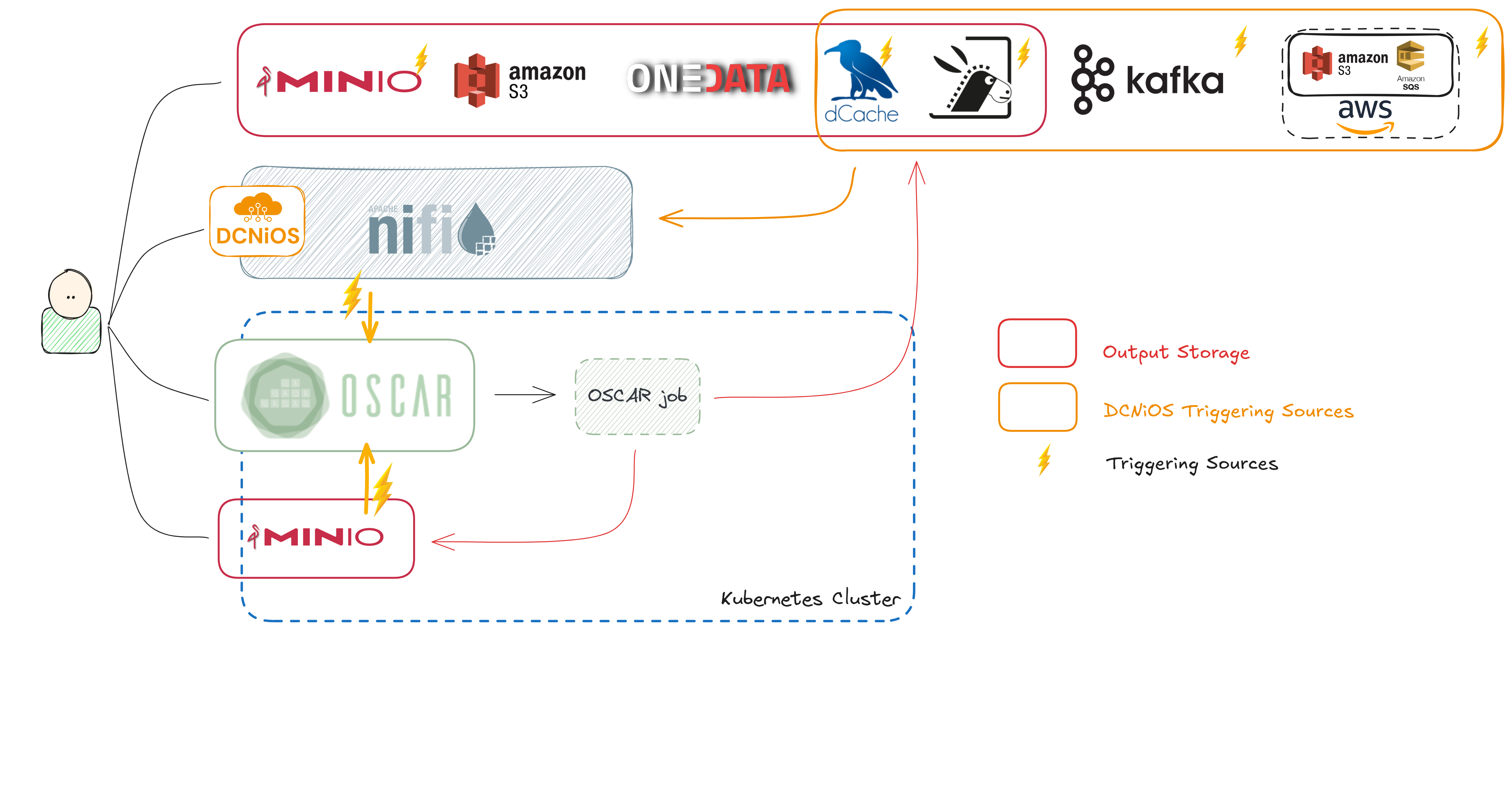
This post summarizes the work carried out in the InterTwin project to extend the OSCAR serverless platform across the cloud–HPC continuum. We developed DCNiOS, a Data Connector through Apache NiFi for OSCAR, that facilitates the creation of event-driven dataflows connecting storages system like dCache, S3 (via SQS), Kafka, and Rucio, enabled seamless offloading of OSCAR workloads to HPC via interLink, added interactive Jupyter notebooks as exposed services, and integrated Common Workflow Language (CWL) using oscar-python from them.
Data-driven ingestion with DCNiOS
We built DCNiOS to connect dCache storage events with OSCAR through Apache NiFi. DCNiOS provides a YAML-based approach and a CLI tool to define and deploy the dataflow that listens to dCache Server-Sent Events (SSE) and triggers OSCAR services.
- What it solves: decouples ingestion rate (dCache) from processing rate (OSCAR) while keeping flows reconfigurable.
- How it’s delivered: a NiFi-based image with SSE client support and reusable process groups.
- Details and screenshots: see our post Data-driven Processing with dCache, Apache NiFi and OSCAR.
New event sources for serverless triggers
We broadened the DCNiOS capabilities to support new event sources for triggering OSCAR services:
- Amazon S3 via SQS: process object-storage events at scale.
- Kafka: stream-processing triggers for high-throughput event flows.
- Rucio: scientific data management events feeding directly into OSCAR services.
These sources are orchestrated through Apache NiFi dataflows and set up with DCNiOS, complementing existing triggers and enabling flexible scientific pipelines.
Rucio demo
We showcased triggering OSCAR functions from Rucio events using DCNiOS, enabling data-driven processing directly from scientific data management systems.
Offloading OSCAR workloads to HPC with interLink (itwinai use case)
We integrated OSCAR with interLink to transparently offload computation from OSCAR clusters to HPC systems. In this setup:
- OSCAR handles the event-driven lifecycle and user-friendly APIs.
- interLink securely offloads pods to HPC under the user’s identity, preserving site policies.
- OIDC-based auth and secure tunneling align with HPC security and networking constraints.
- Storage credentials are propagated from the OSCAR cluster to HPC so data access remains consistent.
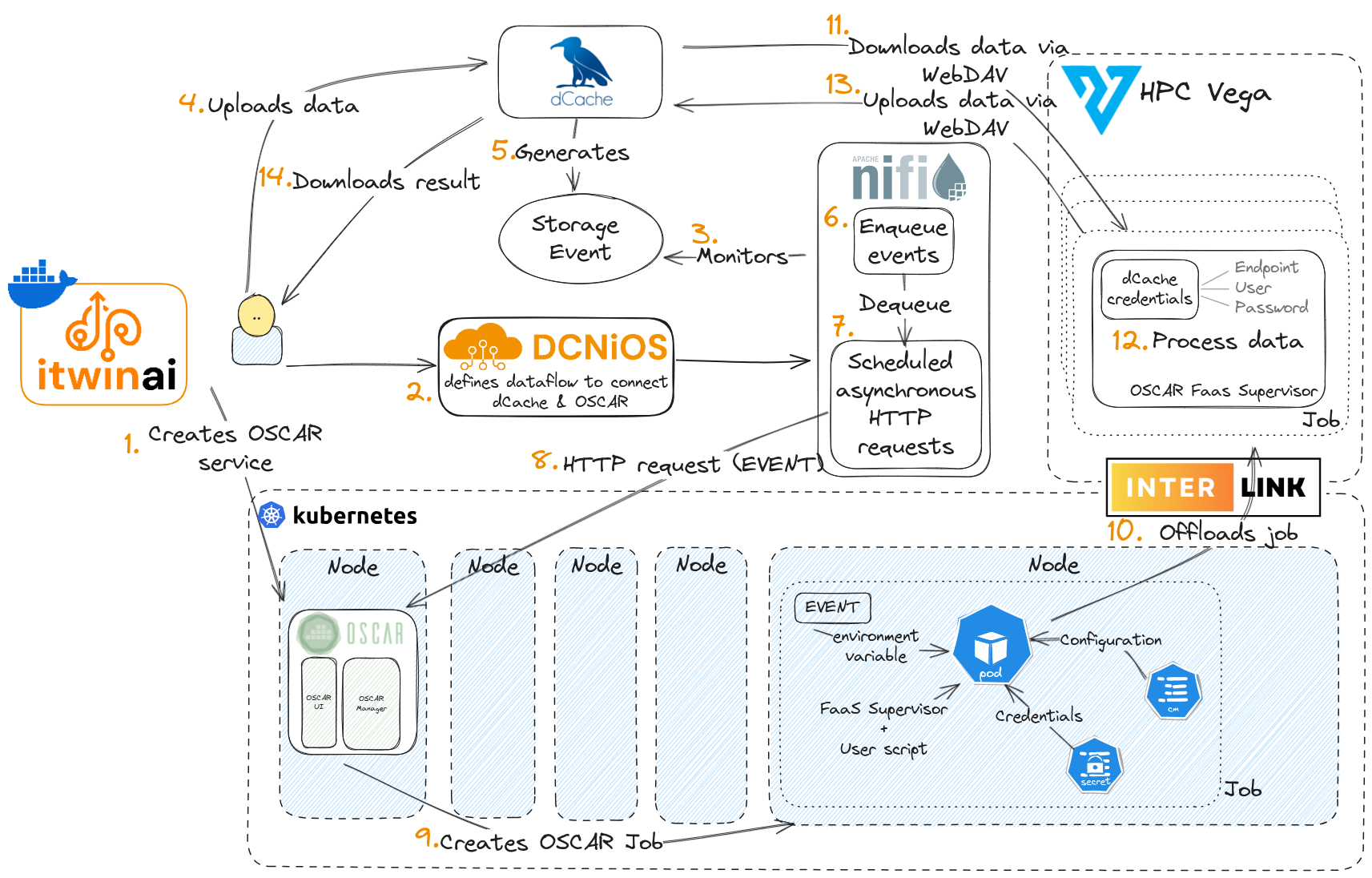
An inference service deployed with itwinai (developed by CERN in InterTwin) demonstrated how HPC compute can be invoked from OSCAR in a serverless manner to perform inference on a generative machine learning model.
Interactive work: Jupyter Notebooks as Exposed Services
We added support to deploy Jupyter Notebooks inside OSCAR as exposed services. Users can interactively develop and run workflows using the oscar-python library, with the notebook’s working directory mounted on MinIO. This allows a notebook to trigger OSCAR functions directly by writing to storage or calling OSCAR APIs, making iterative experimentation simple and reproducible.
- Feature docs: https://docs.oscar.grycap.net/latest/exposed-services/
- Library: https://pypi.org/project/oscar-python/
In the following video, we walk through the process of deploying interactive Jupyter notebooks inside OSCAR and then seamlessly launching a CWL workflow from within the notebook environment.
EURAC: Drought early warning from a notebook
With EURAC, we demonstrated triggering OSCAR services for drought early warning directly from a Jupyter notebook, validating the interactive, event-driven pattern in a real scientific context.
CWL integration with oscar-python (Deltares FloodAdapt)
We enabled the execution of CWL pipelines that call OSCAR services by embedding Python steps using oscar-python into users’ CWL workflows. With Deltares’ FloodAdapt digital twin (focused on compound flood risk assessment and rapid scenario evaluation), we demonstrated how CWL can orchestrate OSCAR services end-to-end.
Closing remarks
InterTwin helped us push OSCAR beyond cloud-only serverless by connecting it to HPC through interLink, streamlining interactive development with notebooks, and widening event-driven integrations. Together, these capabilities simplify building scalable, policy-compliant AI and simulation pipelines across the compute continuum, right where research needs them most.
OSCAR is developed by the GRyCAP research group at the Universitat Politècnica de València. This work was supported by the project “An interdisciplinary Digital Twin Engine for science’’ (interTwin) that has received funding from the European Union’s Horizon Europe Programme under Grant 101058386.